
Learning Saath.
Over the past two weeks, Natassia (the other AIF fellow at Saath) and I learned about Saath’s current projects and visited the “field” (various slum areas in Ahmedabad). I also turned 3 shades darker, have mosquito bites all over my arms, and am constantly “swirty” (sweat (averaging 95-100 degrees) plus dirt (A’Bad is one of the ten most polluted cities in the world).
Saath’s Basic Services.
With India rapidly urbanizing, many of India’s rural poor are migrating to large urban areas – however, they come ill equipped to survive and are forced to settle in the slums. Saath concentrates on these urban slums and provides solutions that are dependent on the participation of slum residents (ie, making citizens pay for services). For example, Saath helped slum citizens obtain constant and legal electricity. Historically, utility agencies viewed slums as a collection of poor individuals who were unable to afford electricity. Without electricity, slum residents were unproductive after sunset as they lacked general power for things I take for granted (phones, lights, etc). Saath by leveraging all the slum residents as a viable, profitable “market” helped negotiate with the government and private sector to provide electricity to each home, complete with meters and utility bills. Subsidies to pay the utility bills were required at first, but the income level of slum residents and productivity are correlated to the quality of basic services, and thus the acquisition of electricity (and water and infrastructure) helped slum citizens generate the income to pay for it.
Community Sustainability.
As a proponent of self-sustainability, Saath has organized Community Based Organizations, groups comprised of slum citizens, to assume leadership/responsibility of Saath’s projects once they become mature. Essentially, Saath helps to implement and monitor projects, but its goal is to not only have the slum residents benefit from, but also manage and operate the development projects. Jysostnaben, a CBO leader in a southwest Ahmedabad slum called Vasna, explained the improvements her community has seen. I only half understood her Gujarati (I’m not improving as fast as I thought I would), but she expressed how with clean water and paved roads disease has decreased substantially. When she took us for a tour of her community, she was often stopped by local residents, both male and female, to ask for her advice or to just say hello out of respect…something extraordinary for impoverished woman in India.
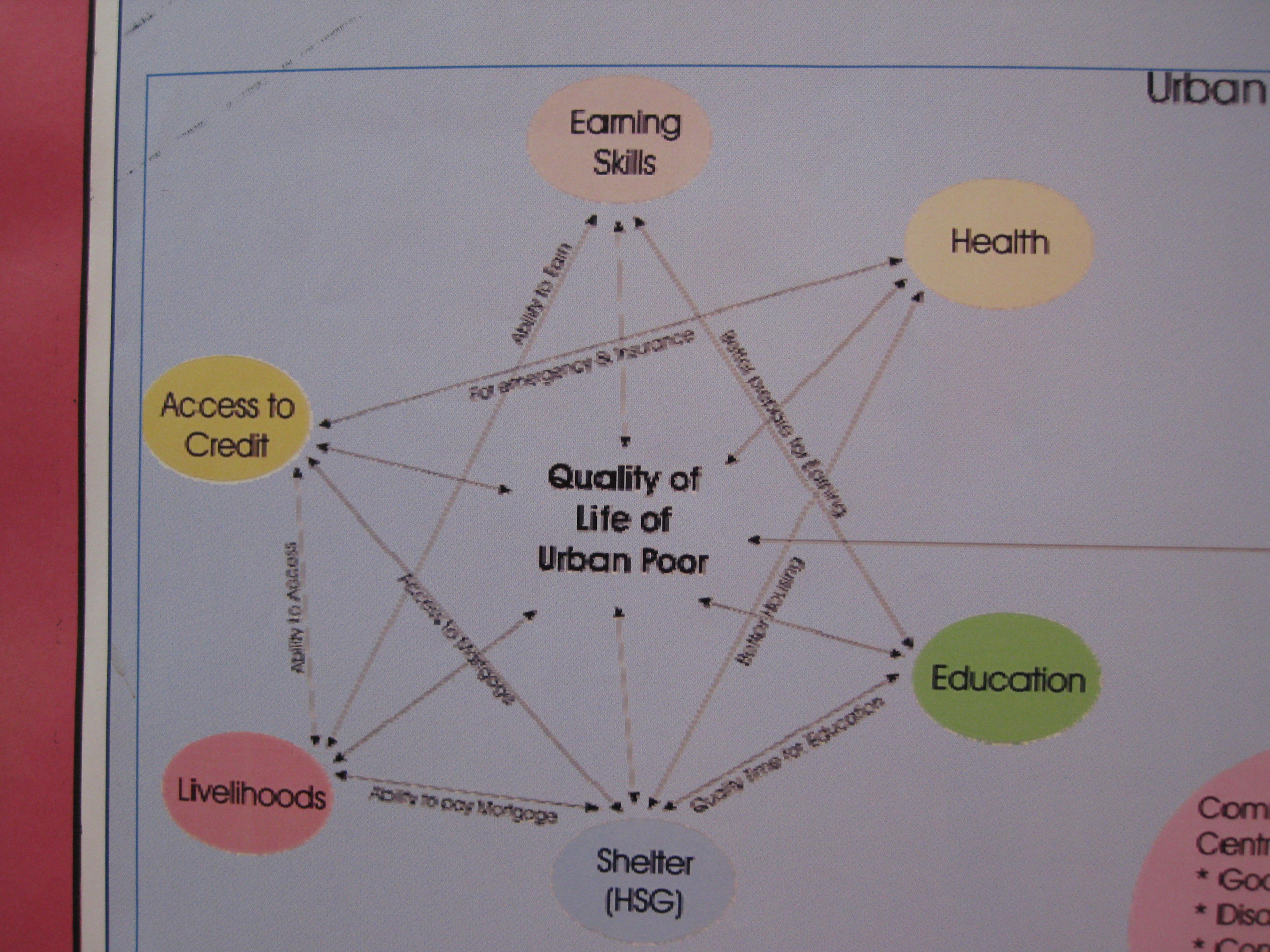
Saath: Integrated Solutions.
Saath’s Livelihood.
I will be working with Saath’s livelihood initiatives, which similar to their Basic Service projects are created to seamlessly transition control from Saath to the community. Specifically, Saath works to develop marketable occupational skills for income generation.
One example is Saath’s “Urmilla” project…In India, many middle class families employ labor to cook, clean, do laundry, and to provide patient care. Saath realized that much of this labor operated on a free lance basis. Saath began training women in the above skills and began placing qualified “Home Managers” with client under the brand name Urmilla. I questioned the desire for a client to employ a slum resident. To remedy that, Saath, at first, used its reputation to appease tentative clients, but over the past 3 years, the program’s success (enrolled over 155 clients) and reputation has provided the necessary reassurance. Saath has also successfully transitioned the Home Manager program to a franchise model with standout home managers assuming franchiser roles.

Applying a SWOT analysis to individual job training.
Saath’s vocational skills program, Umeed, trains underprivileged youth (18-30 years old) in employable skills and facilitates job placement. The students undergo 3 months of training in IT, English, hospitality management and are hired by reputable organizations such as Reliance, ICICI, etc. Given India’s high rates of unemployment, I questioned how these youth were obtaining jobs in such a competitive job market. Apparently, there is a shortage of labor in semi-skilled fields (college graduates aren’t interested in these positions) and so Umeed is providing a necessary supply of labor. The state of Gujarat has adopted Saath’s program and is spreading it across the state.
Microfinance.
This summer, when I was explaining what I would be doing for the next months, I often said “microfinance in India”. Divyang, a manager at Saath who oversees their microfinace project, explained to me in detail what “microfinance in India” really means, specifically related to Saath and the slums ofAhmedabad…
1) Women, tired of their husbands gambling family money away, wanted a way to protect their income and began saving their cash in a community bank.
2) Meanwhile, women needed money to finance consumption (education, healthcare), asset creation (debt reduction, home repairs, vehicle deposits) and enterprise ventures
a. Large banks wouldn’t lend to them as slum residents don’t have collateral
b. The expenses of facilitating a micro loan are not economical to a large bank
3) Women continue to borrow from private lenders with exorbitant rates (i.e, $100 at 50% / month interest)
a. Forced the borrowers to pay $50 of interest each month or $600 of interest the whole year plus the principal of $100 at the end of the year
b. Most loans weren’t profit driven (usually for education, health) and thus unable to pay interest or principal
4) Demand for cheaper borrowing coupled with increased savings led to CBOs lending the communities savings at much cheaper rates
5) As a result:
a. CHEAPER COST OF CAPITAL. Less interest than before equals more cash to spend on improving their lives.
b. INCREASED STATURE OF WOMEN. Ability to secure cash more easily than men, women gained respect and power in their community.
c. GENERATIONAL IMPACT. Investment in education and healthcare, promote prosperity for their children. May not see immediate impact, but children’s lives are improved.

Saath's microfinance annual meeting (300 women attended).
So that’s Saath in a nutshell. I doubt I did it justice – but hopefully, things will become more clear over the next 9 months. Meanwhile, it’s Navratri in Gujarat. Navrathri is a 9 day dance festival (10PM – 3AM) each night. So far I’ve made it through 2/3 of the nights and will spend Saturday night in Baroda (being hailed as the best place for Garba in the world) with Ketu and Chandni.


 finding rickshaw.