
Welcome To The LRC.
LRC Part 1.
After the customary ribbon cutting and coconut smashing (…and a few other traditions), our Livelihood Resource Center (LRC) has opened! Replete with a full time staff, paying members, operational computers – the LRC is serving as a “career center” to youth living in slum areas.
Welcome to the LRC!
The LRC is primarily targeting graduates of UMEED, SAATH’s youth employability training program. UMEED trains slum youth with basic skills in computers, customer sales, hospitality management, etc. and then places them with jobs in the organized and formal sector (surprisingly, there is a demand for labor in India). Call-centers, shopping malls, hotels and nursing care – all part of India’s growing service industry – are in need of entry level labor.
After spending 3 months meeting with faculty, employers, and most enjoyably students and alums, we decided that we were missing a critical piece of youth employability. Most students that I spoke to indicated that they came to UMEED for for computers and jobs, but upon graduation, valued their faculty relationships most. The training we knew was complete – the methodology was proven, funding was in place and the demand for labor was constant – but the support for a graduated students was not there. The mentoring faculty had 150 new students to train and did not have the capacity to counsel alums.

BPO students.
Now, for me, entering the real world after college was extremely daunting even after 4 years of preparation (I may or may not have cried), so I can’t imagine how a youth with limited education and no professional experience could handle a job receiving inbound phone calls from demanding and pushy customers after just 3 months of training. But the youth are succeeding. They have always been capable, they just needed the opportunity.
However, there are those that are unable to negotiate 50 hour work weeks or working on Holidays such as Diwali or Eid. Without a formal support network, they quit and end up with the same informal, unsecure jobs or even unemployed. At the same time, the students who have prospered are often trapped in their entry level positions, unaware of their upward mobility. Finally, after UMEED, many students no longer have access to computers or e-mail.
That’s where the LRC comes in. For us to responsibly help students navigate the fomral sector and to accurately judge the long-term impact of the program – both promotions and attrition – we agreed that we would continue Umeed through a “career center”. In keeping with SAATH’s mission, we require each alum to pay Rs. 500 to promote responsibility and ownership; by paying, youth will be entitled to quality services. To attract the students, we offer a “cyber cafe atmosphere” where youth can utilize e-mail and practice typing and English. We then mentor and cousnel students, introduce them to aluni and prepare them for new jobs.
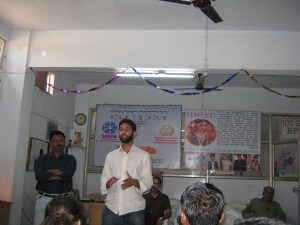
Speaking to students.
Unfortunately, the nominal Rs. 250 charge per student will not keep the center afloat. But again adhereing to what SAATH has proven over the past 20 years, we plan connect the private sector to the untapped potential of our youth. Employers are in need of not only entry-level labor, but also mid-level employees. The latter’s experience significantly lowers the cost of training and attrition for employers. Therefore, employers are willing to pay for mid-level labor, especially if we can respond to their staffing needs quickly and accurately. By enrolling and counseling UMEED graduates, we build a supply of experienced, capable labor and in return, the employers pay us fees that cover our overhead.
The whole process – the idea, diligence, implementation and now execution – has taken longer than anticipated. You can’t put a price on having intimate knowledge of or grasping the lay of the land. Some of things that took me weeks to figure out would have been obvious for someone who speaks better than broken Gujarati or was familiar with Indian and NGO processes. And with the center open, we are facing new challenges (enrollment, expectations, quality of employment), leading me to question whether five months is enough to see the project through.

Installing New Computers.
That said, our primary consitituents are the students and their response has been uplifting. Our first employee, Monil, is a former UMEED student. In his interview, he said he wanted to work at the LRC so that he can give a bit of UMEED back to students. As part of the “cyber cafe” program, he and I require all students to e-mail us weekly. It shouldn’t come as any surprise that our inboxes are already flooded.
Anyone interested in becoming an e-pen pal?


 finding rickshaw.