
Madhuben and Microfinance.
One year ago, I thought I understood microfinance. I had done my research, read Yunnis’ book, and loved Kiva. I thought the premise was simple: provide the poor access to loans, allow them to invest in small enterprises and help them escape from poverty. Since then, I’ve worked with these borrowers, heard Yunnis speak, and debated the merits and ethics of lending to the poor. I now know that microfinance isn’t an immediate and magical solution to poverty reduction. Rather, it is a gradual, (can be) responsible and generational way for the poor to participate in their own development. Much of what I learned was through Saath’s microfinance program, the success of which can be largely attributed to Madhuben
—
She dresses in traditional saris, prefers to speak only in Gujarati, and claims to have never fulfilled her dream of becoming a teacher. A modest description of someone who manages 10,000 banking clients. Hearing her speak about default rates and collateral rates is akin to listening to a CFO during an earnings call. She is Madhuben and she is Saath’s community microfinance coordinator. Madhuben grew up with microfinance, a decade before Yunnis won the Nobel peace prize and Kiva became a global buzzword.
Joining Saath in 1992, Madhuben was one of the few women in her community to have made it through the 12th standard. She earned Rs. 250 a month teaching for Saath’s Balghars program, a much needed slum pre-school program. Over the next four years, Saath’s presence and community staff of primarily women grew. However, they nor their work were readily accepted in the communities. They were assumed to have little qualifications and were often told that “as women, they aren’t capable of working”. To address the lack of services to and power of women, Madhuben and a few others formed a discussion group of weavers, sewers and teachers. News spread virally and soon, 100 members had joined.
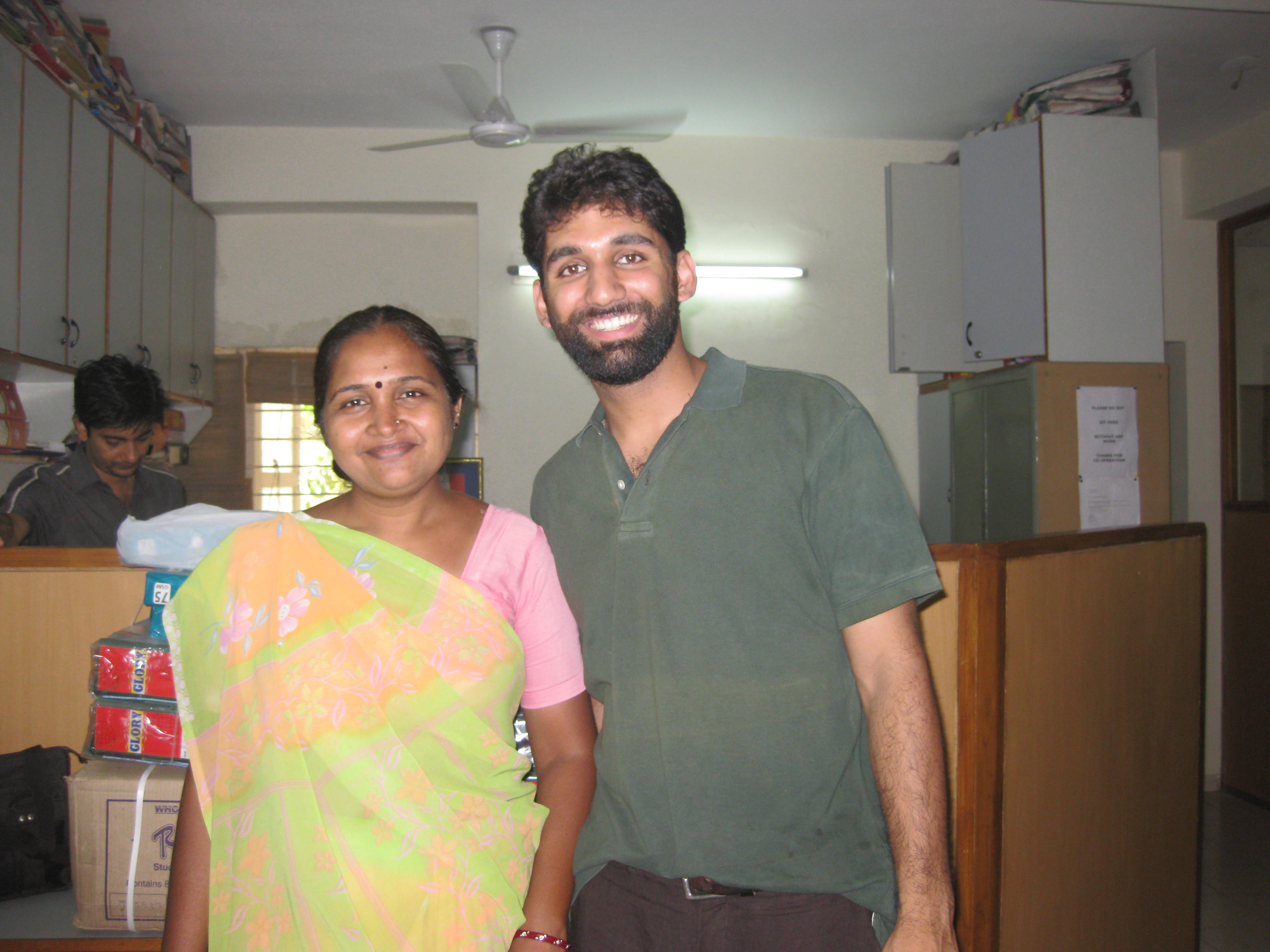
Madhu Ben and Me.
They quickly realized that the most pressing issue was the inability to safely save their earnings for various reasons, including their husbands gambling and drinking their savings. They began collecting Rs. 25 a month and depositing the aggregated savings into interest-earning bank accounts. Their reach accelerated. In two years, they covered almost 1,500 households in the Praveen Guptanagar (PG1) slum area. Madhuben managed 200 of these households. The women gained a dependable place to save and earn interest and Madhuben and her team became respected community leaders. The latter proved invaluable. Many of the amenities and services present in PG1 today such as toilets, street lights, and electricity, were conceived by Saath and the government but were implemented by Madhuben and other local leaders. The mistrust often associated with NGOs and government schemes was mitigated as this group effectively conveyed the program message.
In 1999, as the quantum of savings accumulated, Madhuben and her peers realized that they should also lend money. Microfinance is often marketed as “providing the poor access to lending”, but in reality, the poor have always utilized credit. Long before private equity and venture capital firms realized the market at the bottom of they pyramid, local private money lenders were lending to the poor. These lenders were keenly aware that they were the only source of funds and thereby could lend at a discount and charge 5-10% interest rate on the principal per month. For example, a borrower would receive $90 on a $100 loan and be required to pay $10 each month in interest (10% of $100 regardless of whether the loan was paid back on day 2 or day 360). The resulting 120%+ interest forced borrowers into a unresolvable cycle of debt.
Madhuben says the solution was obvious: “Use the savings to fund loans with responsible terms and rates.” Today, they offer a 24% interest rate charged to the current balance, not the principal (which works out to ~12.5% per annum). Each percent is perfectly allocated between mandatory savings, default protection and administration fees. All profit is given is distributed to the clients as dividends. They lend to joint liability groups – teams of of 4-5 people – to mitigate individual default risk.
Today, microfinance is broadly defined as financial services to the poor but the players and offerings are vast and distinct. At the base level, groups of 10-20 women gather and contribute small savings on a weekly or monthly basis. These “Self-Help Groups” (SHG) then lend out money to the most deserving or vulnerable. On the other side of the spectrum, you have investors playing in the secondary market of microfinance. Mega-million dollar funds have been created to invest in microfinance institutions. With above market returns, these investors have the satisfaction of generating profits and commitment to the BOP development.
Here is where the debate begins though. The increased investment has led to growth of lending into new impoverished areas. Competition and scale ultimately drive down rates, which start off below private lending terms. However, the reach of these microfinance institutions is limited to lending and excludes savings and insurance, and is dependent on external capital. Conversely, institutions that depend on savings to fund loans are have slower growth and consequently, reach and impact. Aware of the ongoing discussion, Madhuben says that lending should only be one part of financial services to the poor: “Microfinance is microlending, savings and insurance. It should be a suite of products that are managed and owned by the community. Without the other products, we would become financially handicapped.”
“Twenty years ago”, she continues, “women had limited or no career options. Homes didn’t have toilets or running water. People in PG1 were perpetually in debt. Today, women are gaining rights and respect, our homes look developed and the difference in interest rates leads to more savings. It is a gradual process, but my children will have better lives. They are even saving in their piggy banks today.”
While Madhuben has benefited from microfinance, she is also why it works so well. Without people like her, microfinance is just a theory. Much of what was once just a large SHG and now is a combined portfolio of Rs. 2.5 crores of savings and loans (1 crore = 10mm) is a result of the application of her initiative, creativity, leadership and modesty.
Divyang, SAATH’s MFI program coordinator and technically Madhuben’s supervisor, admits who the boss really is, “At first glance, I underestimated her but soon I learned more about microfinance in a few days with Madhuben than I had ever known.” He wonders out loud what she would be doing in different circumstances: “In spite of not having a full education, she manages an entire financial system. She is capable of anything and could easily be leading a large company. For her, sky is the limit.”
As humble as ever, Madhuben responds, “All I ever wanted to do was teach. By teaching, I could meet more people, understand and help them achieve their dreams. I still want to be a teacher.”


 finding rickshaw.