Kachch Kachch.

•October 20, 2008 • Leave a Comment

Last Tuesday night, I took an an overnight bus to Bhuj, which is a city in the Kachchh desert of Gujarat. Bhuj was serverly affected by the Gujarati earthquakes in 2001. The government, through economic incentives, has done an excellent job of reviving and rebuilding the city. Kachchh is also known for having extremely talented rural artisans and many NGOs have formed to help monetize the artisan’s livelihoods. In Bhuj, I visited Shrujan (shrujan.org), an NGO that works with rural artisan women.

I will be working with Saath to help create a sustainable, profitable business model for rural artisans near Ahmedabad that employs best practices of other artisan NGOs. Over the next few months, I will spend time with various artisan NGOs in Kachchh.

Traditionally, rural artisans have superb embroidery and stitching talent, but do not have access to market intelligence or financial resources and thereby cannot profit from their livelihood. Shrujan, by procuring materials cheaply on a mass scale, conducting market surveys and marketing/selling product through their outlets, allows artisans to focus purely on their embroidery while maximizing profitability. This model ensures that artisans are paid immediately upon completion of the embroidery and prevents them from collecting excess inventory. In addition, the artisans no longer have to incur debt to procure materials and equipment, which is expensive when done on a one-off basis. I unfortunately did not get to visit with any of the rural artisans, but interacted with the Shrujan staff.

Shrujan is very well run and for 40+ years has assisting artisans with their crafts and in education of life services. The one lingering question I have is the sustainablity of this model; the artisans are dependent on Shrujan for 90% of the supply chain and thus without Shrujan would unable to monetize their trade.

My journey to/from Bhuj was also an experience. The bus seats are very adjustable and on the way there, the person in front of me took full advantage and spent the greater majority of the 9 hour trip sleeping in my lap. Trying to avoid this unwanted spoon on the way back, I upgraded to a “sleeper” compartment. The bus has two levels of sleeper compartments which are closed off by curtains. Measuring 5 1/2 feet long by 3 feet tall by 3 feet wide, the sleeper seat prevented me from lying down or sitting up. Also, at each stop, people routinely would poke their hands through the curtain to check if the seat was empty. Lucky for me, I enjoy the protective fetal position and slept the majority of the trip.

Navratri Finale: “Bo Garba Rum-you”

•October 15, 2008 • Leave a Comment

Scorecared continued:

Saturday, October 4, 2008: We drove 2 hours south of A’bad to a city called Baroda with Chandni (she lives there) and Ketu. Baroda, as hyped by Chandni and confirmed by locals, is known for having the largest and best garbas in India. In A’bad, people dance in their social cliques (that often disbanded when I brought my bad dancing to their circles); so any one venue would have 40 plus small dancing circles. This is very different from the garbas back at home, where everyone moves in the same direction in concentric circles. The Baroda garba was actually similar to the ones at home, but as Chandni described, was 1000x larger. We danced with at least 25,000 other people and were watched by 10,000 more. I can’t think of any other event where that many people are actively participating (excluding competitive superfans). It was a top ten moment. After the garba, we went with Chandni’s uncle to get Pav Bhaje (greasy bread rolls with a delicious vegetable spread) and then went to a high society after party (you can find alcohol in Gujarat!).

I brought a fever and intense headache home from Baroda and took the next few nights off.

Thursday, October 9, 2008: Navratri ended yesterday and today is “Dasara”. Schools and offices are closed as this day is the “anniversary” of the Hindu God-King Ram’s (from the epic Ramayana*) victory over the demon Ravana. I went with my cousin Parag and his family and watched a 10 story tall Ravana doll burn amidst spectacular fireworks.

Error
This video doesn’t exist

*I’ve been saying for years (ask Liz Pingpank) that the Ramayana could be a Hollywood epic along the lines of Lord of the Rings and Braveheart. It’s a magical story that has the mystery, action, love and drama necessary for an epic: Young prince wins beautiful princess’ hand through a feat of strength but then is exiled to the Indian forest where his wife gets kidnapped by the demon king and has to spend the next 10 years searching for his wife with the help of a powerful monkey and his army and ultimately kills the demon king to regain his wife but at the mercy of his subjects questions her purity and ultimately loses her to mother earth but not before she gives birth to twin sons who unknowingly challenge their father, the king.

Saturday, October 11, 2008: Navratri ended last Wednesday, but I guess after Navratri are the after-Navratri garbas. I went with my new neighbors and had a great time. Venue was much smaller, but the quality of dancing was great. Some groups even broke out into choreographed dance (I can see where Bollywood gets it).

I’m still in awe of how massive the Navratri celebrations are here. Even my parents were surprised to hear the stories as the garbas they remember were much, much smaller. Other than the heat, this event is worth making a trip back to India every few years.

Navratri Part Deux: Dancing and in need of Dri-Fit.

•October 15, 2008 • Leave a Comment

I danced for 5 out of the 9 nights of Navratri. October is the third hottest month of the year, so we were routinely dancing in 100 degree heat. I must have lost 5 pounds from all the sweaty dancing. Nike should make Dri-Fit Indian clothes… would be an instant hit.

My dancing scorecard:

Wednesday, October 1, 2008: Went with my cousin Parag, his wife Bhargavi and their son Hersh. Over 2,500 people were “playing” and at least 1,000 were watching. I awkwardly danced with my cousin’s friends and received many stares as I substituted grace with 2 left feet. Our night ended at 1230am. My kurtha (shirt) was soaked with sweat and it took 15 minutes to scrub the dirt off my feet.

Thursday, October 2, 2008: Went to the youth event with Ketu (Anishee’s brother who is working at Morgan Stanley in Mumbai), his cousin and Ekta. Probably 2,000 teenagers and twenty-somethings. Energetic, but very crowded – I sweated through another kurtha…

…I bought both of my kurthas at an outlet sponsored by an NGO that only sold rural artisan clothing. Very interesting business model and is relevant to one of my projects with Saath.

http://www.gramshree.org/about.html

Friday, October 3, 2008: Went to a “high-society” garba with Bhavin’s cousins, Ditti and Shaili, Ketu, Chandni, Ekta and Natassia. The venue was awesome (Desai family: It was Kamor-esque and saw Anuj’s wife Ansini there). Great music, great crowd and again, extremely sweaty.

After each garba, when I would head for the exits with the masses, I got the same feeling as leaving a late-night bar or a club – satisfied, excited and exhausted, sweaty, starving – and just like a Friday or Saturday night at home, everyone heads to get late-night food. The only difference is that I feel much better in the morning after a garba than I do after a typical night at home.

Navratri Part I: Dance Dance Revolution.

•October 14, 2008 • Leave a Comment
25,000 people dancing at a Garba in Baroda.

25,000 people dancing at a Garba in Baroda.

Navratri took over Ahmedabad and Gujarat over the last 2 weeks. Officially, Navratri, which means nine nights in Sanskrit, is the Hindu festival honoring the Goddess Durga and, depending on the state, is celebrated through dance, fast and/or prayer.

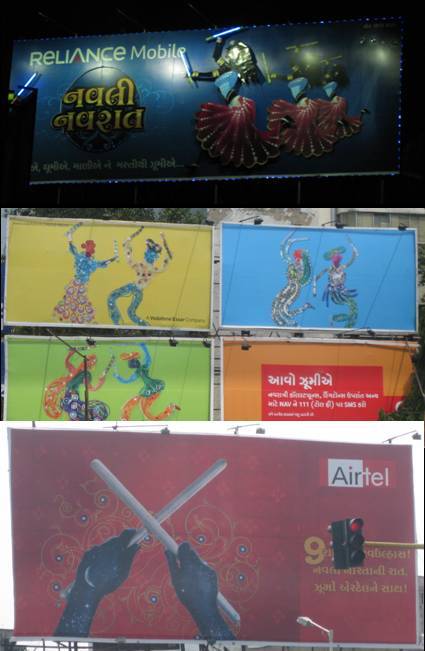
Unofficially, in Gujarat, Navratri is the most social time of the year as people dance until the early hours of the morning. The types of dances are garba (circular dance with coordinated foot and handwork) and raas (yes, Ernie, just like raas chaos, where people perform a variation of garba with small wooden sticks). Unfortunately for me, the dance I know best, Raas, is an urban myth – no one does it. Supposedly as Navratri has become more commercialized (see the sponsor signs above), Raas was dropped due to safety concerns (thousands of people hopping around with sticks?).

Commericalized Garbas.

Commericalized Garbas.

I went to garbas growing up and I wish now that I had used that time to learn proper garba rather than playing parking lot football with my cousins or sitting in the bleachers. Oh well.

The venues in Ahmedabad range from parking lots of apartment buildings to giant football field sized plots and people of all age groups in both traditional and modern outfits either come to participate or to watch. With the lack of any social scene outside of restaurants in A’bad (they just closed all the hookah bars), the large venues are a hot spot for local twenty-somethings. More conservative parents accompany their kids, but children with July birthdays are known as “Navratri kids”…

Lacoste entering the traditional Indian clothing scene.

Lacoste entering the traditional Indian clothing scene.

(My Navratri pictures are uploaded to Picasa and can be accessed from the link on the right; I have a bunch of videos, but my internet connection isn’t strong enough to upload them)

Bringing Piggy Banks Back.

•October 12, 2008 • 1 Comment
ICICI ATM lines in Delhi on Friday as customers cashed out their savings.

ICICI ATM lines in Delhi on Friday as customers cashed out their savings.

The United States isn’t alone in the financial crisis – India’s benchmark index, the Sensex, dropped over 15% last week. On Friday, liquidity rumors began to spread about ICICI Bank, India’s 2nd largest lending institution. Customers flooded local branches hoping to withdraw all of their savings, even as bank and government officials provided guarantees.

I went to an ICICI bank on Friday to try to access my AIF account for the first time, but my spot in line, ticket number 421, was 200th in the queue, so I left, figuring that ICICI bank and my AIF stipend would last the weekend. Let’s go G7.

Does India = Hindu?

•October 3, 2008 • 1 Comment

One more story from our Saath training:

While visiting an called S.nagar in a Muslim area of Ahmedabad, Natassia and I met with Yakubhai, a S.nagar community leader. After touring the microfinance and resource center initiatives, we asked Y bhai whether the children’s schools were integrated with Hindus. He responded, “No, but the Muslim students do have Gujarati teachers”. After letting that comment sink in for a few minutes, I asked him why he differentiated “Muslim” from “Gujarati” and whether he considered himself Gujarati (Yukubhai was born and raised in Gujarat, India). The American translation of this would be Latino or black or any American-born minority who has white teachers saying that he/she was a “black student taught by American teachers”.

Religion tension in Gujarat peaked in 2002 when the infamous Gujarat Riots claimed the lives of 750 Muslims and 250 Hindus. Y bhai said that in the early 1970’s this area was comprised of Hindus and Muslims from Gujarat and neighboring states. He said that he grew up nationalistic and had pride in his state and country. However, as religious conflict escalated over the next 30 years, safety concerns propelled Hindus to migrate from this area and Muslims to move in – a steady course of segregation. After the 2002 riots (where Muslim citizens and business were targeted by Hindu mobs), Y bhai began to categorize Gujarat and India as places where he lived and not as representations of his identity. This identity shift is happening across socio-economic classes in Ahmedabad as well – wealthy Muslims are leaving integrated areas and moving to Juhapura. It was disturbing to hear about this silent segreation, especially within India, which rivals America in religious secularity.

Marketing campaign to rename the Muslime dervied "Ahmedabad".

Gujarat gov't marketing campaign to rename the Muslim derived "Ahmedabad".

One other noticeable characteristic of Y bhai’s slum was the inadequate infrastructure – the lack of flowing water and unpaved roads contrasted the infrastructure of the other areas where Saath works. The cause may be found in the BJP’s ascension to power in Gujarat. The BJP has done much for Gujarat, but some critics argue that this Hindu centric government has subordinated the needs for its Muslim citizens.

Learning Saath.

•October 3, 2008 • Leave a Comment

Over the past two weeks, Natassia (the other AIF fellow at Saath) and I learned about Saath’s current projects and visited the “field” (various slum areas in Ahmedabad). I also turned 3 shades darker, have mosquito bites all over my arms, and am constantly “swirty” (sweat (averaging 95-100 degrees) plus dirt (A’Bad is one of the ten most polluted cities in the world).

Saath’s Basic Services.

With India rapidly urbanizing, many of India’s rural poor are migrating to large urban areas – however, they come ill equipped to survive and are forced to settle in the slums. Saath concentrates on these urban slums and provides solutions that are dependent on the participation of slum residents (ie, making citizens pay for services). For example, Saath helped slum citizens obtain constant and legal electricity. Historically, utility agencies viewed slums as a collection of poor individuals who were unable to afford electricity. Without electricity, slum residents were unproductive after sunset as they lacked general power for things I take for granted (phones, lights, etc). Saath by leveraging all the slum residents as a viable, profitable “market” helped negotiate with the government and private sector to provide electricity to each home, complete with meters and utility bills. Subsidies to pay the utility bills were required at first, but the income level of slum residents and productivity are correlated to the quality of basic services, and thus the acquisition of electricity (and water and infrastructure) helped slum citizens generate the income to pay for it.

Community Sustainability.

As a proponent of self-sustainability, Saath has organized Community Based Organizations, groups comprised of slum citizens, to assume leadership/responsibility of Saath’s projects once they become mature. Essentially, Saath helps to implement and monitor projects, but its goal is to not only have the slum residents benefit from, but also manage and operate the development projects. Jysostnaben, a CBO leader in a southwest Ahmedabad slum called Vasna, explained the improvements her community has seen. I only half understood her Gujarati (I’m not improving as fast as I thought I would), but she expressed how with clean water and paved roads disease has decreased substantially. When she took us for a tour of her community, she was often stopped by local residents, both male and female, to ask for her advice or to just say hello out of respect…something extraordinary for impoverished woman in India.
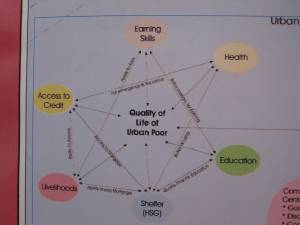
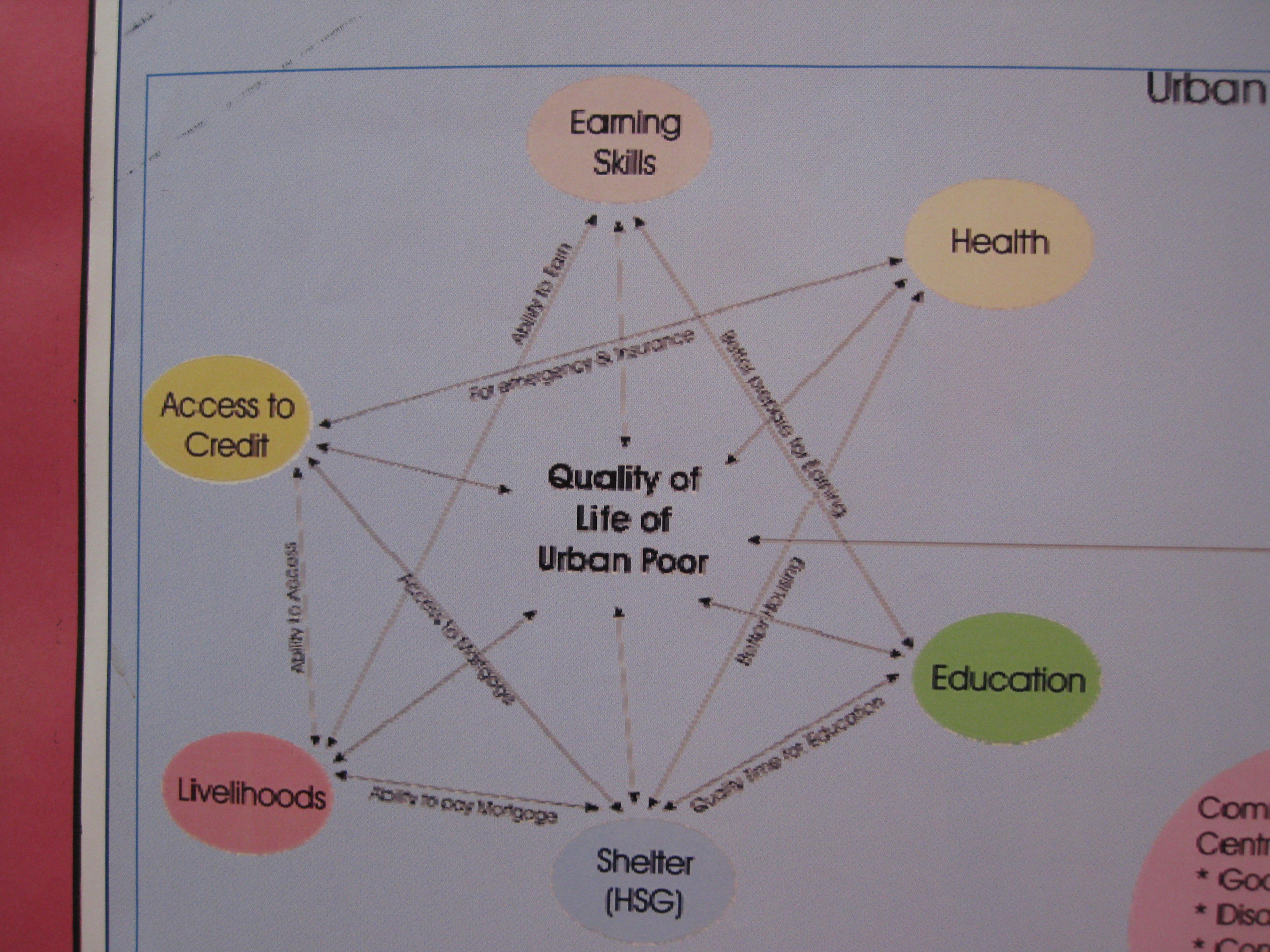
Integrated Solutions.

Saath: Integrated Solutions.

Saath’s Livelihood.

I will be working with Saath’s livelihood initiatives, which similar to their Basic Service projects are created to seamlessly transition control from Saath to the community. Specifically, Saath works to develop marketable occupational skills for income generation.

One example is Saath’s “Urmilla” project…In India, many middle class families employ labor to cook, clean, do laundry, and to provide patient care. Saath realized that much of this labor operated on a free lance basis. Saath began training women in the above skills and began placing qualified “Home Managers” with client under the brand name Urmilla. I questioned the desire for a client to employ a slum resident. To remedy that, Saath, at first, used its reputation to appease tentative clients, but over the past 3 years, the program’s success (enrolled over 155 clients) and reputation has provided the necessary reassurance. Saath has also successfully transitioned the Home Manager program to a franchise model with standout home managers assuming franchiser roles.
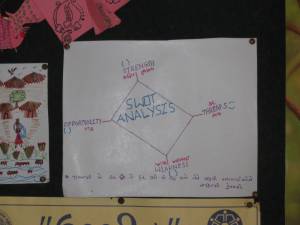
Applying a SWOT analysis to individual job training.

Applying a SWOT analysis to individual job training.

Saath’s vocational skills program, Umeed, trains underprivileged youth (18-30 years old) in employable skills and facilitates job placement. The students undergo 3 months of training in IT, English, hospitality management and are hired by reputable organizations such as Reliance, ICICI, etc. Given India’s high rates of unemployment, I questioned how these youth were obtaining jobs in such a competitive job market. Apparently, there is a shortage of labor in semi-skilled fields (college graduates aren’t interested in these positions) and so Umeed is providing a necessary supply of labor. The state of Gujarat has adopted Saath’s program and is spreading it across the state.

Microfinance.

This summer, when I was explaining what I would be doing for the next months, I often said “microfinance in India”. Divyang, a manager at Saath who oversees their microfinace project, explained to me in detail what “microfinance in India” really means, specifically related to Saath and the slums ofAhmedabad…

1) Women, tired of their husbands gambling family money away, wanted a way to protect their income and began saving their cash in a community bank.

2) Meanwhile, women needed money to finance consumption (education, healthcare), asset creation (debt reduction, home repairs, vehicle deposits) and enterprise ventures

a. Large banks wouldn’t lend to them as slum residents don’t have collateral

b. The expenses of facilitating a micro loan are not economical to a large bank

3) Women continue to borrow from private lenders with exorbitant rates (i.e, $100 at 50% / month interest)

a. Forced the borrowers to pay $50 of interest each month or $600 of interest the whole year plus the principal of $100 at the end of the year

b. Most loans weren’t profit driven (usually for education, health) and thus unable to pay interest or principal

4) Demand for cheaper borrowing coupled with increased savings led to CBOs lending the communities savings at much cheaper rates

5) As a result:

a. CHEAPER COST OF CAPITAL. Less interest than before equals more cash to spend on improving their lives.

b. INCREASED STATURE OF WOMEN. Ability to secure cash more easily than men, women gained respect and power in their community.

c. GENERATIONAL IMPACT. Investment in education and healthcare, promote prosperity for their children. May not see immediate impact, but children’s lives are improved.

Saath's Microfinance Annual Meeting (300 women attended).

Saath's microfinance annual meeting (300 women attended).

So that’s Saath in a nutshell. I doubt I did it justice – but hopefully, things will become more clear over the next 9 months. Meanwhile, it’s Navratri in Gujarat. Navrathri is a 9 day dance festival (10PM – 3AM) each night. So far I’ve made it through 2/3 of the nights and will spend Saturday night in Baroda (being hailed as the best place for Garba in the world) with Ketu and Chandni.

First week of work. End of days for Lehman.

•September 18, 2008 • 1 Comment

it’s the end of days for lehman brothers. obviously, the smartest financial minds decided that helping aig, freddie and fannie was more critical to the financial system than helping lehman, but what I can’t get over is the amount of people who went into 745 7th ave on sunday to clean out their desks. 3 years ago, that would have been me. 4 years ago, i would have had a 1 year lease in nyc with no income to pay for it. 5 years ago, many of my good friends from georgetown and michigan and i would have been scrambling for jobs as the campus recruiting center would likely have been a ghost town.

last june , when the sub-prime crisis became public and the credit crunch started, the attitude on the street was that the market would rebound in early 2008. at work, people were less optimistic and my friend, kal, kept warning me that the financial system was broken. in my previous two jobs, i worked closely with the debt markets and looking back, it was incredible to see how everyone’s risk appetite kept increasing (including me, i was bullish about most deals). i can now see how we got ourselves into this mess, but during orientation, a few of the fellows asked for a simplified explanation. click on the picture below for a humorous and simple explanation of the sub-prime mess:

i’ve completed my first week of work. rajendra joshi (raju bhai), my mentor and founder of saath, set up a one week orientation for natassia and me. we’ve been visiting with the saath’s different slum development projects (microfinance, vocational services, resources centers, health awareness, artisan organization, etc.). we sit down with raju bhai on tuesday to determine our projects for the next 9 months. from what i’ve seen, the projects fit saath’s mission to provide an “integrated approach to slum development”. they help secure basic essentials (water, electricity, housing) for slum dwellers through ownership (not charity) strategies. they help educate, empower and train people to allow them to secure jobs in proper ahmedabad. the services are mostly fee-based services so the recipient has a stake and a say in the quality and a sense of ownership. i will write more on each of saath’s projects once i learn more and will post what my specific project will be next week.

wishing everyone at lehman the best of luck.

Arrive in Ahmedabad, Bombs in Delhi.

•September 14, 2008 • Leave a Comment

5 bombs went off in Delhi last night. Thankfully, I left Delhi yesterday morning and everyone I know in Delhi is safe. The blasts took place in Connaught Place, a very commercial area and the same place that I had had lunch with Anuja and Rishi the week before. I was at my uncle’s place in Ahmedabad when the bombs went off. I was surprised that they weren’t more alarmed by the news – it was if they were desensitized to it. At home, whenever I read on cnn or on the ticker of some tv channell that “Bomb blast in [non-western country], kills [###]”, I usually think about it for a few minutes and then then am distracted by what I was originally doing. The same group that took credit for the July Ahmedabad bombings, Indian Mujahideen is assuming responsibility for these blasts. I’m definitely not distracted now.
Orientation had a fitting farewell. We performed our Bollywood Naach (Naach = Dance) (not intended for those with sensitive ears) and went out for dinner and drinks. I had fun during orientation. While it was hectic at times, I thought AIF did a great job of presenting all so many issues and organizing distinguished speakers. I enjoyed spending time with the other fellows; we found common interests, laughed, drank, mafia-ed and had heated arguments about trivial and controversial subjects. I think we will all pick up where we left off at midpoint in January. One other highlight of orientation was meeting Sridar Iyengar, the AIF board member responsible for the Service Corps. Sridar, the former CEO of KPMG India, has devoted his life to both social development in India and to pursuing global business ventures. He treated us to a VIP dinner at his new Japanese restaurant / lounge, AI, in Delhi.

I start work on Monday and am not sure what exactly to expect. Saath, during the few minutes I spent in the office and from what I heard from the AIF team, is extremely professional and has accomplished a considerable amount. The AIF staff also informed us that that our hours could range from 5 hours a day to 12 hours a day, the latter, a product of waiting for mentors and managers to come back from meetings to assign work. The bankers (Michael (my roommate), Hemant and I got a kick out of that.

First 9/11 Abroad & First Microfinance Experience.

•September 11, 2008 • Leave a Comment

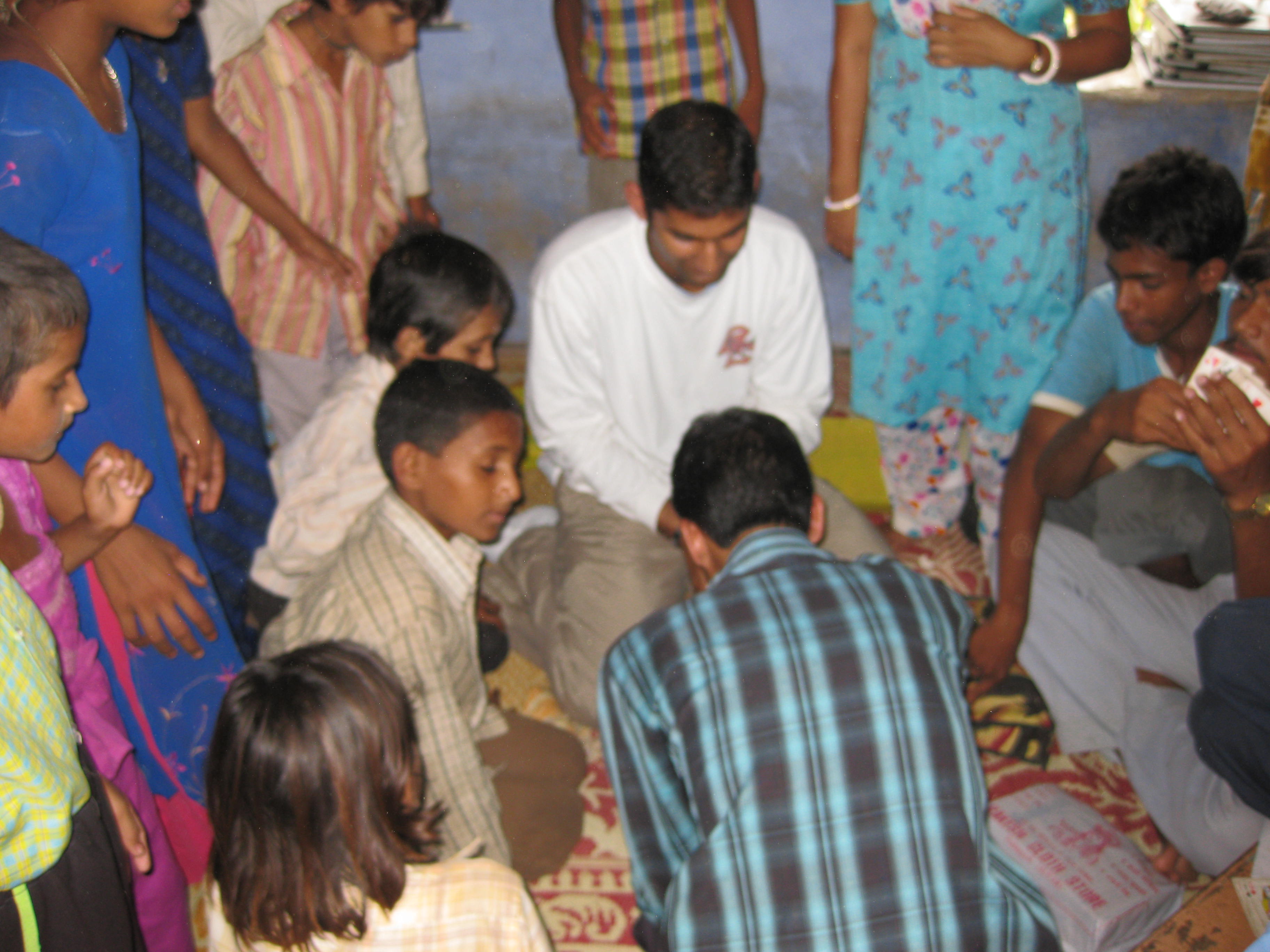
We just returned from Atwar, Rajisthan, where we spent two days visiting an education and microfinance NGOs. Its rural location provided us unpolluted air and we saw the sky and moon for the first time since arriving in India. After talking about microfinance for the past year, it was incredible to see it live and it proved to be very educational.

I’ve realized that my understanding of the impact of a small loan was very wrong. I thought that women were receiving loans, investing in small enterprises (ie, buying a cow), selling the milk for an income far greater than the loan and interest and using the net profit to climb out of poverty. Instead, the loan is primarily used to lower a borrower’s cost of capital. Naively, I assumed the recent microlending proliferation in rural areas was the first access that villages had to borrowing. Lending has been going for years, but rather than small, well-intentioned NGO’s facilitating the exchange, private lenders were lending money at exorbitant rates (50-100%). Microfinance has helped villages access cheaper money (50% vs. 20%) and borrowers can use the net savings on lifestyle improvements. At the end of our meeting, the women asked us to “tell them how they can improve their lives and become wealthy”. We were all speechless.
A microfinance SHG (self help group) in Atwar, Rajisthan.

Sharing magic tricks with Atwar children.

Sharing magic tricks with Atwar children.

The second week of training has gone by quickly, as I’ve adjusted to the schedule of speakers, site visits, paneer filled meals and even the dreaded stomach ailments. I would like to write about the speakers because 1) I don’t want to forget what they said and 2) many of them were of notable distinction and achievement and I want to share their views, but it would take 20 pages to do so. Instead, I’ll list some of the highlights and links.

Orientation Highlights:

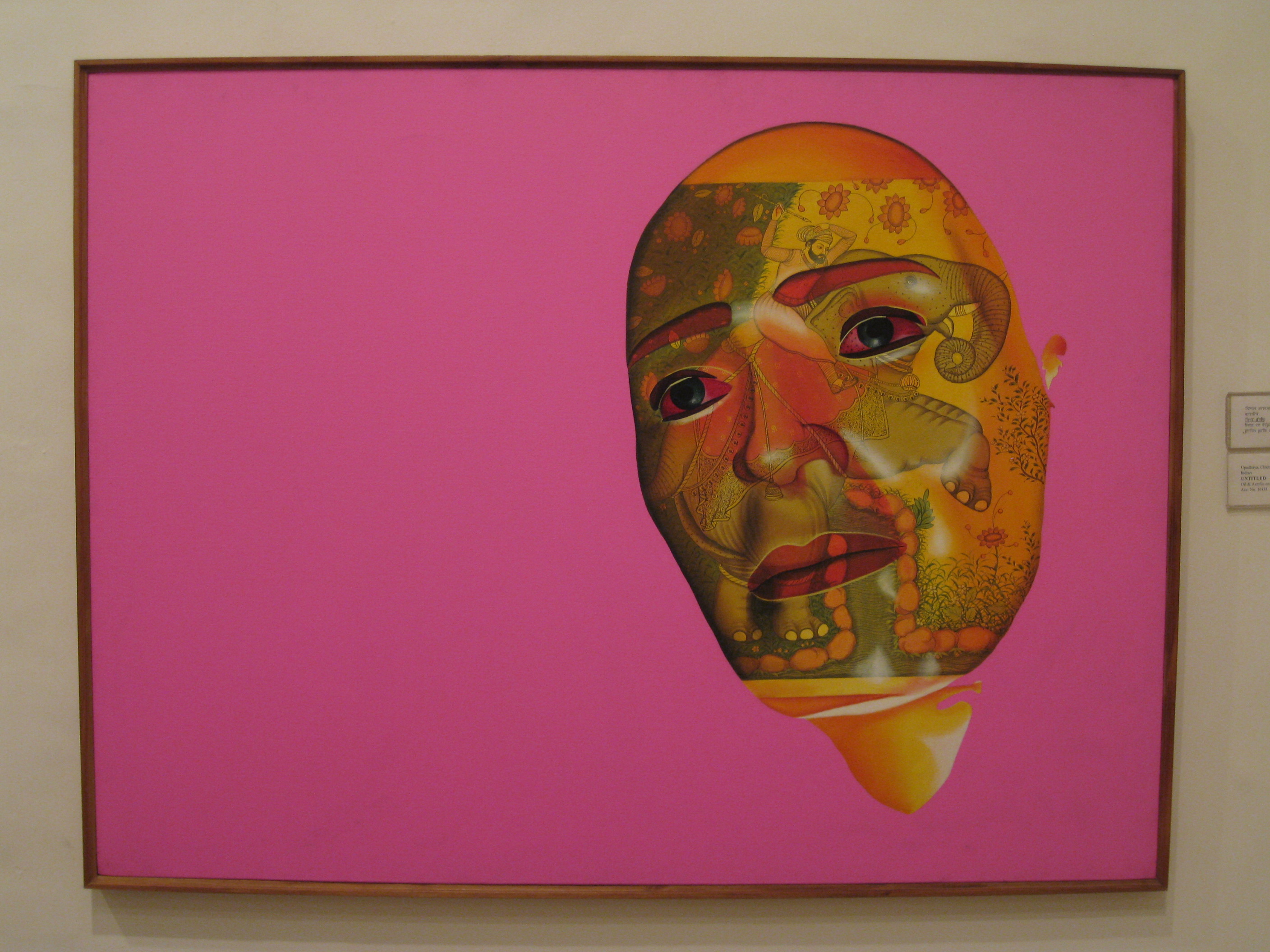
– Private tour of the Indian National Gallery of Modern Art

art can be found in a root canal.

art can be found in a root canal.

– George Abrahim, founder of the World Cup of Cricket for the Blind

– Dinner at Acqua, a posh new club at the Park hotel hosted by Priya Paul, AIF advisory board member

– Discussion with Pratham (educational NGO that has helped over 200,000 kids become literate)

Ashoka Fellows

– Human rights conversation with Harsh Mander, author of Unheard Voices

Jonathon Ripley’s discussion on Kothi’s (must read, through the eyes of Carolyn, a fellow fellow)

Today is also September 11th, but in Delhi, it is just an ordinary day. While we were in Altwar yesterday, we walked through a village where the MFI NGO was. While touring the village, I often shaped my hands in the Indian prayer form and said Namaste to the villagers as a way of saying hello. A fellow fellow was quick to point out that not everyone in the community was Hindu. Embarrassed at first, I realized that here in the villages of India, which account for nearly 75% of India’s population, Hindus and Muslims were living in harmony. India continues to suffer from religious conflict in other parts of the country, but here on the 7th anniversary of 9/11, it was encouraging to see.