Abu Dhabi to Ahmedabad Direct – Guest Blog.

•May 4, 2009 • Leave a Comment

I live in Abu Dhabi. For those that have never been or even heard of the UAE’s capital, it’s located on a tiny peninsula dotted along the Persian Gulf, a short hour drive from (now) infamous Dubai. More importantly, Abu Dhabi is also just a three hour flight from Ahmedabad and, considering how my friend Rick has lived there for nearly 8 months, I felt obliged, motivated, and of course delighted to accept his invitation to go and visit him. I had heard stories from other friends how “Banker Rick” had enthusiastically turned into “NGO Rick*” and was now doing tremendous work with Saath, the non-profit that had motivated him to leave the glamorous corporate private-jet life he was living in Chicago for a simple good-will endeavor. As seeing is believing I booked my flight and decided to verify this rumor in persona.

Then...

Then...

I arrived at Ahmedabad International airport sometime around 4am, and with non-existent Gujarati, a heavy German accent, and what must have been a rather disheveled appearance searched first for my luggage and then for Rick in a sea of taxi drivers, baggage handlers, wild stray dogs, and the usual hustling and bustling one encounters at the airport. Standing in the hot humid air, my eyes darting left and right, looking for that beautiful familiar face, I deeply sympathized with the Elephant Man; fairly certain that at his very moment in time I was the only Westerner in Ahmedabad. After a brief memory lapse on how I had been convinced to come to Ahmedabad of all places, Rick parted the sea of strangers and kindly rescued me from the starring masses, allowing my first trip to India to commence.

Now I have traveled to third world countries quite a bit but living in what Fortune Magazine has repeatedly labeled “the richest city in the world” has skewed my perception of the real world to an admittedly great degree. Zooming through this eccentric city, scanning the streets left and right, I was smacked square as you may say, for the first in a long time, with reality. I first sensed, and then noticed that the quiet streets were alive. Men and woman, children and babies were sleeping on the side-walk; many without even so much as a make-shift shelter. I think it was right there and then that I was reminded that not Abu Dhabi, with its noveau lifestyle funded by the millions of barrels of oil money or Dubai with its Palm islands and tallest buildings in the world were the real world; but that this very city in India, Ahmedabad, in the great province of Gujarat contained the real truth.

Early the next morning awakened by the buzzing fan cutting through the thick air I peeked out of the window, cautiously I might add, and unsure of what I would find in the daylight. To my surprise I saw a city bustling with life. The sidewalks were filled with merchants and vendors –the city had come alive. After a rapid 10 minute rickshaw ride, which should have taken much longer considering the lack of airbags and the driver’s total disregard for human life, we began the day by visiting Saath where Rick introduced me to some of his colleagues and explained the general workings of the organization and its mission in this state. The city, one of the most diverse in India, is made up of Hindus and Muslims, who after periods of violent conflicts, are currently living peacefully side by side. Ahmedabad is split fairly even between these two demographics and Saath is strongly committed to enhancing the life of the poor of both religious groups. After a few brief conversations confirming that Rick actually worked here and wasn’t just on a year sabbatical, we headed to one of the Umeed’s locations, which is a vocational training program set up by Saath. Comprised of various courses, Umeed provides young adults the opportunity to acquire basic skills to secure entry level positions across multiple business sectors.

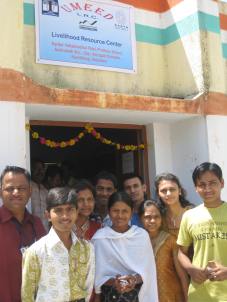
Umeed students.

Umeed students.

As we arrived, several classes were underway including Nursing and Marketing. Entering one of the classrooms, the instructor halted the lesson and rising as one, the students provided us with a warm welcome. It’s quite a sight to see Rick in action. With a focused approach he singles out student after student encouraging them to answer in English, emphasizing the need to practice, always practice, asking them to share their experiences of the past days and to convey any concerns they may have with the program. The impact volunteers such as Rick have on these young adults is manifested in their interaction. Surrounding Rick, they are eager to share their stories and curious to hear his. While Rick is catching up with the Marketing students I’m led into the Nursing class and clumsily introduce myself to a room full of girls in the only comprehensible way I can muster –wild awkward hand motions.

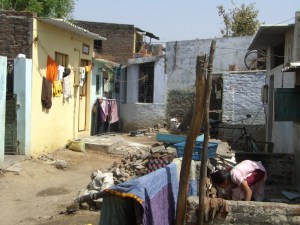
What I find most remarkable about Saath (besides the classes offered through Umeed) is Saath’s presence in the slums. Walking through the narrow passages of these “cities within cities” the real impact of the NGO is evident. The standards are higher than I expected. In my shallow knowledge of the slums (which is purely based off Slumdog Millionaire) I envisioned heaves of garbage lining the streets, mudded cardboard huts and absolute misery but it’s not so. The streets are paved or at least graveled, and electricity boxes hang on more than just a few of the huts. Saath outposts are numerous, whether in the form of Umeed centers or micro-finance institutions. Rick tells me how the organization has raised the standards in many of the slums in Ahmedabad and beyond and continues to do so across the region with increased government support. It’s also interesting to see Hindus and Muslims living peacefully together; Rick narrates the past conflicts between the religious groups and I’m fairly certain he is basing the extent of his knowledge on the film Ghandi (though I unfortunately cannot prove this).

Children in Vasna wearing electrion campaign hats.

Children in Vasna wearing election campaign hats.

I must admit that even though this trip had its price – I spend the better part of the week bonding with my bathroom – it was an experience I’m glad I pursued and will remember in the years to come. It’s tremendous to witness the dedication that NGOs such as Saath and its volunteers provide to those less fortunate, foregoing self-enriching opportunities to enhance the lives of others. It was a stern reminder that my current circumstance isn’t the only thing to value and I’m confident that for those that will take the time to visit or even give their own time to such programs as Rick has, it will be an invaluable experience as well. And if you happen to be a Westerner traveling to Ahmedabad don’t fear this strange the city, for the only truly frightening thing is Rick’s handlebar moustache.

...now.

...now.

-Felix

*Rick’s Note: The events that transpired between April 18th to April 19th have been removed.

“Rick Desai, You’ve Been Invited to MyDailyFlog.”

•April 30, 2009 • Leave a Comment

That makes three invitations this week alone. A popular social networking site among Indians, MyDailyFlog promotes photo-based interactions among friends.  However, I wasn’t invited by my Amdavadi friends (all four of them); members of the Livelihood Resource Center befriended me. After helping each member register for g-mail (just for p&e) and requiring them to send one email per visit, we figured we would help improve their typing speeds and written English.  We didn’t expect their staggeringly quick adoption to social media.  Social networking, job sites, cricket and bollywood chats and live news feeds are just some of the sites frequented daily.

Flogging.

Flogging.

This market should prove very attractive when considered in the context of the global growth of social networking, facebook widgets and iphone apps.  I wonder if Max Zuckerberg includes urban slums when projecting new membership.  He should start. This just hammers home, again the untapped potential that rests here. All that is needed is an opportunity…or an internet connection.

Today, Raju Bhai introduced me to a Bangalore based NGO that utilizes networking as part of an e-learning suite targeted to this market. Aakash from QUEST Alliance (http://quest.eeaonline.org) explained how through distance learning, visual teaching and social networking, education and vocational training at the low income level can be done, well frankly, better, specifically in terms of enduring effect, time and quality.

Per usual,  I am now obsessed with the company and its mission. Quest plans to implement some of their programs at Umeed over the next few months and I’ll share more then.

A Bisleri Half Full Optimist – Guest Blog.

•April 28, 2009 • 1 Comment

I’m a Bisleri half full optimist to the core. But since I returned to India this January, my conviction about the country’s destiny has met much resistance. From corporate fraud, to the understated impact of the global recession on economic growth, to fears of an imminent war, to the frustrating state of Indian politics and democracy, I must admit even I have become a bit disheartened.

Luckily, my spirit was rejuvenated rather quickly during a visit to Saath, an Ahmedabad based NGO focused on slum development, where my good friend Rick Desai has been working over the past eight months. During the three-hour morning tour, I felt oceans away from the tacky theatrics of the political stage and the sophisticated sounding but mostly nonsensical commentary on the Bombay Sensex. Instead, I witnessed the implementation of genius ideas and the resulting tangible progress, all narrated by the Saath representatives who make it happen day after day.

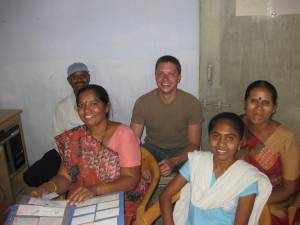
Our day started at the largest UMEED center in Behrampura, Saath’s vocational training program, where students aged 18-30 regularly attend classes in subjects such as English, computers, or customer service in preparation for entry into India’s private sector. In the ‘Livelihood Resource Center’, a new program initiated by Rick, students were putting in extra time practicing their typing and logging into their brand new e-mail accounts. In the center of the room, two girls were busy preparing for upcoming interviews with a call center and a home appliance retailer.

Next door, a fresh batch of students listened as a senior Saath instructor introduced them to the training program. Rick interrupted the session to introduce us and share some motivational words in his broken yet charming Gujarati. As I stared across to the 20 or so young students, I noticed a strangely familiar look in their eyes – the same look I’ve seen during countless interactions with young employees in retail stores, restaurants, hotels and offices across India. It’s a look of ambition, determination, energy and pride. When thought of as a collective force – hundreds of millions strong – it’s a competitive advantage no other country can match in scale and intensity. The optimism came rushing back!

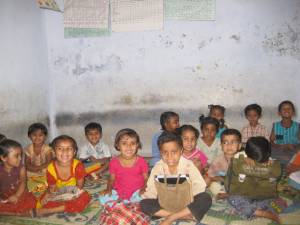
At the Balghars, a pre-school education program.

At the Balghars, a pre-school education program.

From UMEED, we headed to a Muslim slum in Juhapura and visited a preschool and a microfinance institution. As we walked through the narrow lanes, Rick pointed out the recent advancements brought about with Saath’s help – paved roads, metered power, streetlights, sewage systems, and water supply, to name a few. From there, we headed to Saath’s Urban Resource Center in Vasna to meet with Devu Ben, a revered community resident and Saath employee for 20 years. She graciously offered her time and walked us through their home manager program, a private enterprise aiming to organize the domestic housemaid industry.

Across Saath’s programs, one rule stays constant: No free handouts. All their services are paid for at least in part by the direct beneficiaries. This enables the NGO to experiment with sustainable and profitable development ideas that could ultimately be scaled across Gujarat, across India and potentially beyond. However, my takeaway from the tour was that action, not just ideas, was at Saath’s core. Saath’s unique genius is its ability to take action by building consensus around an initiative, which means garnering support from slum residents, Government, and private companies, simultaneously.

This execution capability, Rick explains to me, comes directly from Saath’s founder, Rajendra Joshi. Now that sounds like a true leader – is there a write-in section on the National ballot?

With the tour winding down and our observations from the morning slowly digesting, we began to discuss future opportunities and challenges for Saath and UMEED. How can Saath maintain quality controls as it expands? Are there feedback mechanisms in place to ensure the curriculum is designed to meet the human capital needs of the economy? Where can technology be used to help scale, add efficiency, and create value?

These opportunities call upon another promising demographic, the new generation of well-educated Indians with a strong desire to create meaning and value. As these young entrepreneurs come up with innovative ways to channel the ambition, energy and determination of the greater pool into dignified jobs and valuable output, India’s destiny as a prosperous nation will not only be achievable, it will be inevitable.

– Aniket Shah

700 Million Voters Strong.

•April 28, 2009 • Leave a Comment
The Players.

From the left: BJP's LK Advani & Narender Modil. From the right: Congress' Sonya Ganhi and Prime Minster Manmohan Singh

The world’s largest democracy is holdng elections this month (April 30th in Gujarat).  To be honest, I knew nothing of Indian politics before moving here.  But over the past 8 months, I’ve picked upon the key players, parties and issues.   It’s incredible how in a month’s time 700+ million come out and vote.  I’m always amazed about how in India things that seem impossible always find a way to work out.

I’d blog about it…but Hamsa, a fellow fellow, did it perfectly on our AIF blog:

http://aifservicecorps.blogspot.com/2009/04/rock-vote-by-hamsa-subramaniam_9881.html

In addition, check out these BBC blogs for basic but helpful information on India’s elections:

Election Quick Guide:  http://news.bbc.co.uk/2/hi/south_asia/7938369.stm
Profile of Main Players:  http://news.bbc.co.uk/2/hi/south_asia/7940666.stm
Battle Ground Maps: http://news.bbc.co.uk/2/hi/south_asia/7968638.stm
Election in Numbers:  http://news.bbc.co.uk/2/hi/south_asia/7972675.stm

Swindled.

•April 27, 2009 • 1 Comment

This post is from early March.

In late February, I went to Abu Dhabi to visit my friend Felix and meet Mihira on her spring break.  When I got to the Ahmedabad airport, I was informed that I was going to miss my connecting flight.  All the flights were on-time, but to transfer from Mumbai’s domestic to international airport would take 30 minutes or so.  Given that I had purchased the entire ticket through Jet Airways,  I was able to convince them to book me on an earlier flight on another airline.  They warned me that I would still be cutting close, but I wasn’t alarmed.

Now, this is a large departure from the old Rick who to avoid travel anxiety arrived at the airport 2 hours before a domestic flight.  I had lived in India for six months and had not encountered any severe travel difficulties that weren’t immediately resolvable.  Typical, overconfident American.

I landed in Mumbai and was told that the connecting bus had just left and that my only alternative was to take  a taxi for Rs. 150 ($3) to the other airport.  I hustled outside (mistake #1) drawing the attention of a few pushy drivers insistent on taking me to the airport.  The prepaid taxi line was at least 20 minutes long, so I agreed and followed one guy to his car (mistake #2).   A five minute jog and a drenched shirt later, I was led to a dark parking lot where I got into a car that had 2 people in the front seat.  They gave me a price sheet and said that it would be  Rs. 500 ($10).   Converting into dollars and considering the time, I agreed (mistake #3).  As we turned out of the parking lot, I was told that if I wanted to get there in under 15 minutes, it would be Rs. 1,000.  Now, feeling like I had no choice and thinking that $20 was better than missing my flight and sleeping in the airport, I handed him a Rs. 500 note and 5 Rs. 100 notes (mistake #4).   Moments later, he turned around and while flaunting my money in the air, he sternly said that I had only given him Rs. 500.  Anxious Rick was back.

I began muttering in broken Gujarati about how he was ripping me off.  He understood every word and turned the tables.  Accusing me of lying, he began to empty his pockets to prove his innocence.  He told me not to worry and said that I could just pay in US Dollars.  I told him I wasn’t American (he laughed) and didn’t have any dollars, just rupees.  Defeated, I gave him another Rs. 500 note, effectively bankrupting myself (mistake #5).  Unappeased, he told me that the total wasn’t Rs. 1,000 but Rs. 2,500 because it was at night – he even pulled out a new pricing sheet to support his case.  At this point, I was in a random alley at 10PM in between Mumbai’s domestic and international airports, with no money, 95% sure I was going to miss my flight, drenched in sweat from the heat, and with two men who were milking me for what came to be one month AIF living stipend.

I told them I had no more money (mistake #6) and began to threaten to jump out of the car (I’m all talk, I had a large suitcase).  Right then we conveniently pulled up to an ATM machine.  Option A: Go inside and get the Rs. 2,000 extra or Option B: Get out of the car and walk away.  I chose Option A, took my camera and passport with me and hoped that the car wouldn’t drive away with my stuff.  I gave the guy the money and as soon as I did, another car drove up.  I was transferred into that car and proceeded to the airport.  Very well thought out operation.

I lost Rs. 3,000 ($60) on what should have been a free bus ride.   I did however make my flight (last one on…felt bad for the family in my row though).

I’m done with Mumbai*.  I love simple Ahmedabad.

*April 19 weekend has since converted me into a huge Mumbai fan.

From CEOs to Slums, My Trip to India – Guest Blog.

•April 22, 2009 • Leave a Comment
My Travel Party.

My Travel Party.

I visited India last month for two weeks as part of a trip with the Kellogg School of Management. I traveled throughout the country with 50 business school students, where I enjoyed amazing food, saw beautiful places and got to know a great group of people. The trip was set up to allow MBA students to study the economic and political trends ongoing in India, and we were quite fortunate to meet many of the country’s top business and government leaders.

The highlight of my trip, however, was breaking from meetings for a couple days to visit my good friend and former co-worker Rick in Ahmedabad. While I had a pretty good idea of what Rick was up to from his blog and email updates, I was truly amazed by seeing his work in action.

Slum youth in Vasna.  Saath trains them for formal jobs.

Youth that Saath trains for formal sector jobs.

During my visit, Rick showed me around the slums of Ahmedabad, where his organization works to help provide invaluable financial banking support, healthcare and education programs. I was shocked at the progress he had made since moving to India last summer. Specifically, I was most impressed with the “career centers” Rick had helped set up. These centers, set up by organizations like SAATH but run by local tenants, allow youth to come in and receive training in essential computer and English-language skills for very little cost. Unbelievable that a program that one of my peers works with makes such a significant difference in peoples’ lives, taking slum tenants from living in the slums to working legitimate service sector careers at banks, call centers and hotels in a short few months.

A slum where Saath works w/ paved roads, sanitation and electric meters.

A slum where Saath helped residents pay for paved roads, electricity and sanitation.

Pre-school education.

Pre-school education.

It’s hard to describe the extent of the poverty in cities like Ahmedabad to my friends back home in the states, because I’ve literally never seen anything like it. I’m proud to know that Rick is spending his time and energy on such a worthy cause and couldn’t have been more impressed with his progress in less than a year. Rick, thanks again for taking me out, putting me up and letting me post a little about my India experience on your blog – it was truly incredible to be able to witness a side of India that you simply can’t access as part of an American tour group. Keep up the great work but come back soon – Chicago misses you.

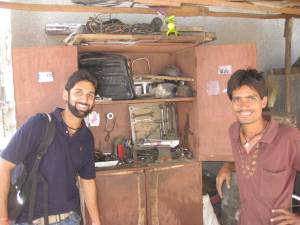
Rick with a local entrepreneur.

Rick with a local entrepreneur.

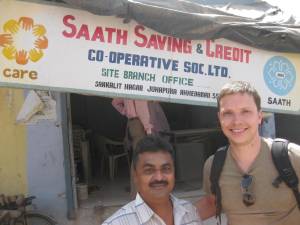
Yaqoob Bhai, a community leader, and me at the MFI.

At the microfinance bank w/ Yaqoob a community leader in Juhapura.

– Steve

The Attack of The Pigeons.

•April 15, 2009 • 1 Comment

I hate pigeons.

This morning, I stepped out of my bathroom and was attacked by a pigeon.  It snuck in through a slightly cracked window and when I opened the door to my bedroom it flew directly for my head.  Both of us were startled; I fell on my back and the bird began to flap around repeatedly ramming itself into the glass windows.  After a five minute negotiation, the pigeon finally left, but not before leaving its mark.   I spent the next 30 minutes cleaning the random pigeon poop that was all over my apartment.

This wasn’t the first time my apartment was attacked by pigeons.  When the AIF fellows were in Ahmedabad, Michael and Carolyn’s friend, Phil, came back to my apartment and were greeted by four pigeons (after a thorough investigation, it was proven that Hemant left the window open…).  Too afraid to go into my apartment, they called on my neighbor to come in and chase the pigeons away with a broom. Again, not before pooping on every piece of furniture in my apartment.

These piegons own Ahmedabd.  Their green and white droppings cover every side walk in the city.   They are even more scary when they move around in groups because you are certain to get pooped on…I think Professor Grant was right.

Disregards.

Slip & Fall at the Taj Mahal.

•April 10, 2009 • 1 Comment

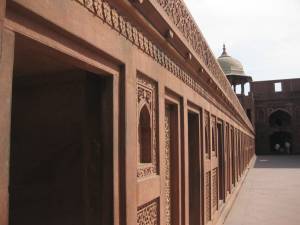
It took me 6 prior trips to India and 7 months this time, but I finally visited the Taj Mahal.  I was in Delhi for a microfinance conference (I heard Muhammed Yunnis speak, more on that later), so I came a few days early to sight see.  Carolyn, a fellow fellow, joined me and we visited the Taj, Agra Fort, from where the Mughals governed India and the beautiful abandonned red sandstone city, Fatehpur Sikri.  I was blown away by the Taj.  I had heard from some that the Taj didn’t live up to the hype; I thought the history, the symmetry and the size made it breathtaking.

taj

The Taj (courtesy of Carolyn)

Back in October, a few fellows began “jumping” when taking pictures with attractions in the background.  I clearly followed the trend and have been picture jumping since.  Believing that the Taj would serve as a beautiful backdrop, I started scoping out spots.  It didn’t quite work out as planned.  My stream of consciousness at the time:

“…this platform is high enough…tell carolyn to stand below the platform…perfect backdrop…i hope she takes it while i’m in the air, it’ll make a great facebook profile pic…maychul will be jealous…ok, jump!…pick up your knees, it looks better…look down to land…oh shit, not that much room to land…i’m going to end up in the water…be athletic and side step it…side step, idiot, not trip!…i’m going in…put your hands down, brace your fall…don’t dislocate your shoulders…don’t drink the water…i’m drenched…get up…play it cool…dammit, people are laughing…they’re clapping? smart asses…smile it off…i hope carolyn got the picture at least…oh no, my blackberry was in my pocket, i’m ruined…why is security approaching me…i’m screwed…no, mr. security guard, I was not pushed in, no one did this to me, no one assaulted me, I don’t need medical attention…i’m just an idiot.”

uh oh

ruh-roh.

((un)fortunatley, Carolyn is a concerned friend and rather than continuing to snap pictures as I took a dive, she came to my aid. so there is no proof that I didn’t jump from 20 feet and that the Taj pool wasn’t 50 feet deep)

look cloesely

View from Agra Fort (courtesy of Carolyn)

Agra Fort.

Agra Fort.

View from Agra.

View from Agra Fort.

fatapura

Fatehpur Sikri (courtesy of Carolyn).

Hemant and Clara.

Fellows Dinner; Clara and Hemant.

Fellows dinner; Carolyn and me.

Fellows dinner; Carolyn and me.

About SAATH.

•April 6, 2009 • Leave a Comment

Raju Bhai was nominated for the 2007 Social Entrepreneur of the Year by the Khemka Foundation.  The organization produced the below video, which explains SAATH’s objectives and programs.  It also provides a glimpse into the areas Natassia and I have worked over the past 7 months.

The Past Week At Work.

•March 30, 2009 • Leave a Comment

A lot happened at work this week, so I thought I’d summarize in a list*:

tash and kris

Kris and Natassia

5.  AIF Visit. Kris Drasgupta, the COO of AIF came to visit Saath.  Ekta, Natassia and I had a great dinner with her on Tuesday night, where we learned more about AIF’s boardroom roots and where the organizations is planning its future.  On Wednesday, we gave her the grand Saath tour, focusing on Umeed.  Kris spent 20 years on Wall Street, so it was interesting to hear her perspective on the program.  We visited the centers, met with currently employed alums and I was able to show her the Livelihood Resource Center in Behrampura and explain the need for post-placement support and new job opportunities for Umeed students.

img_5474

Steve with URC staff, where new technology is a must.

4. Technology. A software firm specializing in on-line recruitment / placement approached Rajubhai to market their program to place Umeed students.  Saath, with its integrated development approach (banking, health, education, livelihoods, etc.) realizes the value of tracking data at a household / individual level.  So, when we saw the capability of their software we asked them to join us in the field for a day.  It was amazing.  The engineers were in awe of the scope of Saath’s programs and when we explained that slums represent 40% of the local population, all the lightbulbs went on.  Together, we are trying to develop a customized software that can track individuals characterisitcs (education, skills, etc.) and the impact of Saath’s services.   The appropriate technology is the key to linking this untapped supply potential with the private sector.

3. Urmila. My favorite program at Saath is the Urmila Home Manager program.  Urmila (the name of Laxhman’s wife in the Ramayana) aims to bridge the gap between “domestic servants” and urban households.  If you’ve been to India, you know that many homes of all economic levels employ “servants” to clean, wash clothes and cook at wages far below the government approved levels.  In addition to exacerbating the unorganized work force issue in India, employing domestic servants does not provide total client satisfaction.  Household help can often not be trusted to work alone, is not accountable on a daily basis and provides no service guarantee. Urmila started 5 years ago and trains slum women who were free lancing as domestic servants in housekeeping, first aid, cooking, etc and then finds them formal clients.  Urmila charges respectable fees for their managers and in return, the clients receive guaranteed, timely and professional services.   As the demand for Urmila Home Managers increases, Saath is begining to explore ways to scale the model across Gujarat and then India.  I’m helping the Urmila team create an implementation strategy.

baroda studetns
LRC Opening.

2. My Dad and the New LRC. On Thursday, we inaugurated and opened a new Livelihood Resource Center in Baroda.  Baroda is 2 hours south of Ahmedabad and is the home of 11 Umeed centers.  It is also where my Dad studied medicine back in the early 70s.  My dad, who came back to India to spend a week with me, was asked by the Umeed staff to cut the ribbon.  We were both hesitant at first, but when he saw the scene of students, new members and faculty, he became excited.  Amidst the commotion, my dad even found his way to a computer and began his own typing practice (15 WPM).  We asked the current Umeed students at the Baroda center (who were extremley sad as it was their last day) what they would change about Umeed.  They almost unanimously responded “make it longer”.   Positioning the LRC as the “ongoing” Umeed, we pre-registered nearly half the class.

Meanwhile, at our existing LRC in Behrampura, we have enrolled 70 members, 50 of which come 3x a week to sharpen their computer skills.  We’ve set up e-mail addresses for each member and are encouraging them to write at least one e-mail a day (if anyone is interested in an e-mail pen pal, let me know!).  These 70 members also give us a supply to market “mid-level” candidates to our partner employers.

Pops

Pops

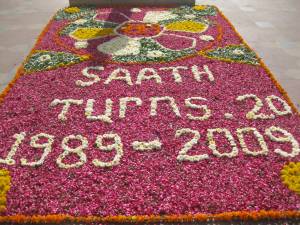
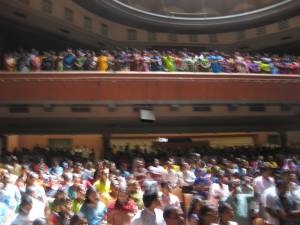
1. 20 Years at Saath.  On Saturday, Saath celebrated its 20th anniversary.  At a local town hall, Saath’s Community Video Unit (comprised of slum residents) prepared tribute videos, local community residents gave their personal triumph stories and Saath awarded community leaders who have served their neighbors and friends over the past 20 years.  I’d estimate that nearly 1,000 community residents came to not only thank Saath and Rajubhai, but also their local leaders on all that they have done.  It was moving to see such a response.

Saath Turns 20.

Saath Turns 20.

Community Participation.

Community Participation.

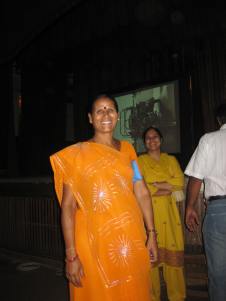
Devuben from the Vasna slum has helped her community for nearly 20 years.

A community leader from the Vasna slum, Devuben has worked with Saath for 20 years.

Saath's #1 Fans.

Saath's #1 Fans.

*Pooja Bhatia, AIF Fellow in Bhilai (ie, the best spot in India with a steel mill that no one knows about) was the first person EVER to operate a blog in a list format.